Motive, the AI platform for physical operations, today announced AI-powered Fatigue Detection, AI-powered Eating Detection, and AI-powered Collision Detection as part of a set of new AI Driver Safety capabilities designed to detect early signs of unsafe driving and capture low-severity collisions such as sideswipes and fender benders often missed by telematics alone. The new AI models are designed to give organizations earlier visibility into risk and can help teams respond to incidents and resolve claims faster.
This press release features multimedia. View the full release here: https://www.businesswire.com/news/home/20260512494274/en/
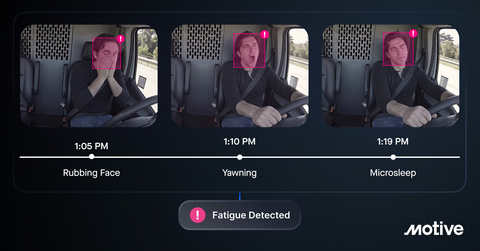
Motive’s AI-powered Fatigue Detection identifies six key fatigue indicators and sends real-time in-cab alerts to get drivers off the road before a collision occurs.
Distraction and fatigue are leading causes of preventable collisions, yet many high-risk behaviors go undetected until after an incident. Fatigue alone accounts for over 100,000 crashes, 800 deaths, and 50,000 injuries annually. Without real-time visibility into unsafe behaviors, safety teams lack the context to intervene early and coach effectively. When incidents do occur, telematics often miss low-severity collisions, which complicates claims, delays response, and increases liability.
“Distraction and fatigue are among the most preventable causes of collisions, but they’re also the hardest to catch early,” said Hemant Banavar, Chief Product Officer at Motive. “The risk shows up first in subtle behaviors, like eye rubbing or small lapses in attention, that most systems miss. Motive detects those signals in real-time and filters out false positives, so teams can act on real risk before it turns into a collision.”
Motive brings detection, validation, and action together into a single system to give organizations earlier visibility into risk. New AI-powered Driver Safety capabilities include:
- AI-powered Fatigue Detection: Built on escalating risk signals, Motive connects six key indicators, including face rubbing, stretching, eye rubbing, yawning, lane swerving, and microsleep, to detect fatigue early and get drivers off the road before a collision occurs. For example, Rubbing Face Detection detects frequent face touching and early signs of restlessness that signal declining focus before fatigue escalates. On-device AI will soon deliver real-time, in-cab alerts so drivers can take action immediately. Safety teams can see all behaviors on a single event timeline with context such as drive time and historical fatigue trend in the Motive Dashboard. Motive’s AI-powered Fatigue Detection is fully enabled on existing Motive AI dash cams—no additional hardware required.
- AI-powered Eating Detection: Eating can nearly double collision risk, yet more than half of drivers admit to doing it, and most systems fail to detect it reliably. Motive’s edge AI identifies when drivers are actively eating to reduce distraction and prevent collisions. Behavior is only detected under high-risk conditions, including when food is clearly visible in a driver’s hand or mouth and eating lasts five seconds or more, to reduce false positives and eliminate noise.
- AI-powered Collision Detection: Traditional telematics often miss low-severity collisions such as sideswipes and fender benders, delaying incident response and increasing liability. Motive combines telematics with computer vision to accurately detect more collisions across all severity levels—while avoiding false positives—capturing, within the camera’s view, incidents such as light rear-end collisions, fast sideswipes, and minor bumper taps or scrapes in tight spaces or traffic. Managers receive real-time alerts with video and telematics data to resolve claims faster, exonerate drivers, and better protect their organizations.
“We are primarily an over-the-road irregular route carrier, meaning our drivers do long hauls, do not consistently go to the same locations, and we also have a large number of team drivers in our fleet,” said Western Express Director of Safety Daniel Patterson. “Due to the nature of our operations, fatigued driving is a concern we are continually trying to raise awareness on and coach drivers on. Fatigue doesn’t show up all at once; it builds through small behaviors like yawning or rubbing your eyes, which are easy to miss. Motive’s new fatigue AI helps us identify these early signs, enabling productive coaching conversations and, in some cases, intervention to get drivers to a safe location before anything happens, including outside of business hours. Motive’s AI Assistant can also interact with drivers in real-time to help them recognize those signs of fatigue and possibly find a safe place to rest, with the potential to significantly improve fleet safety.”
The Motive AI Dashcam uses on-device AI models to detect more than 20 safety events, including AI-powered Lane Swerving Detection, AI-powered Smoking Detection, and AI-powered Forward Parking Detection, with up to 99% accuracy. Since 2023, the Motive AI Dashcam is estimated to have helped prevent over 170,000 accidents and saved 1,500 lives.1 On average, customers that used Motive’s AI Dashcam reduced collisions by 80%2 and accident-related costs by 63%.3
According to a recent IDC Business Value White Paper, The Business Value of Motive: Accurate AI for Fleet Safety, interviewed organizations reported an average 95% reduction in at-fault collisions. In initial head-to-head trials, they saw on average 50% higher AI accuracy with Motive and, after adoption, on average 92% higher confidence in preventing unsafe driving behaviors. These gains translated into more than 8x return on safety investment and over $1.8 million in annual safety savings per organization, driven by fewer incidents and lower risk-related costs.*
The Motive Driver Safety product uses AI Dashcam data from more than one million vehicles and assets to simulate, annotate, and train models on tens of millions of events annually, delivering real-time, in-cab alerts directly from on-device AI with no cloud delay or human intervention. Every event is then validated by EVE, Motive’s Event Validation Engine, which uses AI and targeted human review to help remove false positives and ensure managers only see accurate, high-confidence events. With AI Dashcam Plus, managers can instantly reach drivers via live two-way calling, while the Motive AI Assistant will soon be able to automatically call drivers through the dash cam when fatigue is detected—prompting them to pull over and rest, ensuring support even when managers are offline. This approach delivers both instant protection for drivers and greater accuracy for safety teams.
Learn more about Motive’s accurate AI capabilities here.
About Motive
Motive empowers the people who run physical operations with tools to make their work safer, more productive, and more profitable. For the first time, safety, operations, and finance teams can manage their workers, vehicles, equipment, and fleet-related spend in a single system. Motive serves nearly 100,000 customers from small businesses to Fortune 500 enterprises such as Halliburton, KONE, Komatsu, NBC Universal, and Maersk across a wide range of industries including transportation and logistics, construction, energy, field service, manufacturing, agriculture, food and beverage, retail, waste services, and the public sector.
Visit gomotive.com to learn more.
|
____________________ |
|
1 Since January 1, 2023, based on Company estimates |
|
2 Based on an internal study of customers with at least 90% AI Dashcam adoption for at least 12 months. |
|
3 Results are calculated based on customer responses, management estimates, and internal data. |
|
* Source: IDC Business Value White Paper, sponsored by Motive, The Business Value of Motive: Accurate AI for Fleet Safety, doc #US54413826-BVWP, April 2026 |
View source version on businesswire.com: https://www.businesswire.com/news/home/20260512494274/en/
Media gallery