Vadzo Imaging explains embedded camera lens selection, FOV calculation, and focal length matching across its MIPI camera series, Gigabit Ethernet camera series, and USB camera series, addressing the seven optical design parameters sensor format, focal length, FOV, F-number, TTL, relative illumination, and distortion that determine whether a vision system meets its spatial accuracy requirement at deployment.
FORT WORTH, TX / ACCESS Newswire / June 9, 2026 / Vadzo Imaging, a provider of embedded vision camera for OEMs and system integrators, is addressing one of the most consequential and frequently underestimated decisions in vision system design: embedded camera lens selection. For engineers building production vision systems on any embedded platform, the lens is not a downstream accessory. It is the optical decision that fixes the relationship between sensor format, working distance, and usable field of view before a single line of application code is written. Get it wrong, and no amount of ISP tuning or software correction recovers the scene coverage, spatial resolution, or geometric accuracy the system requires.
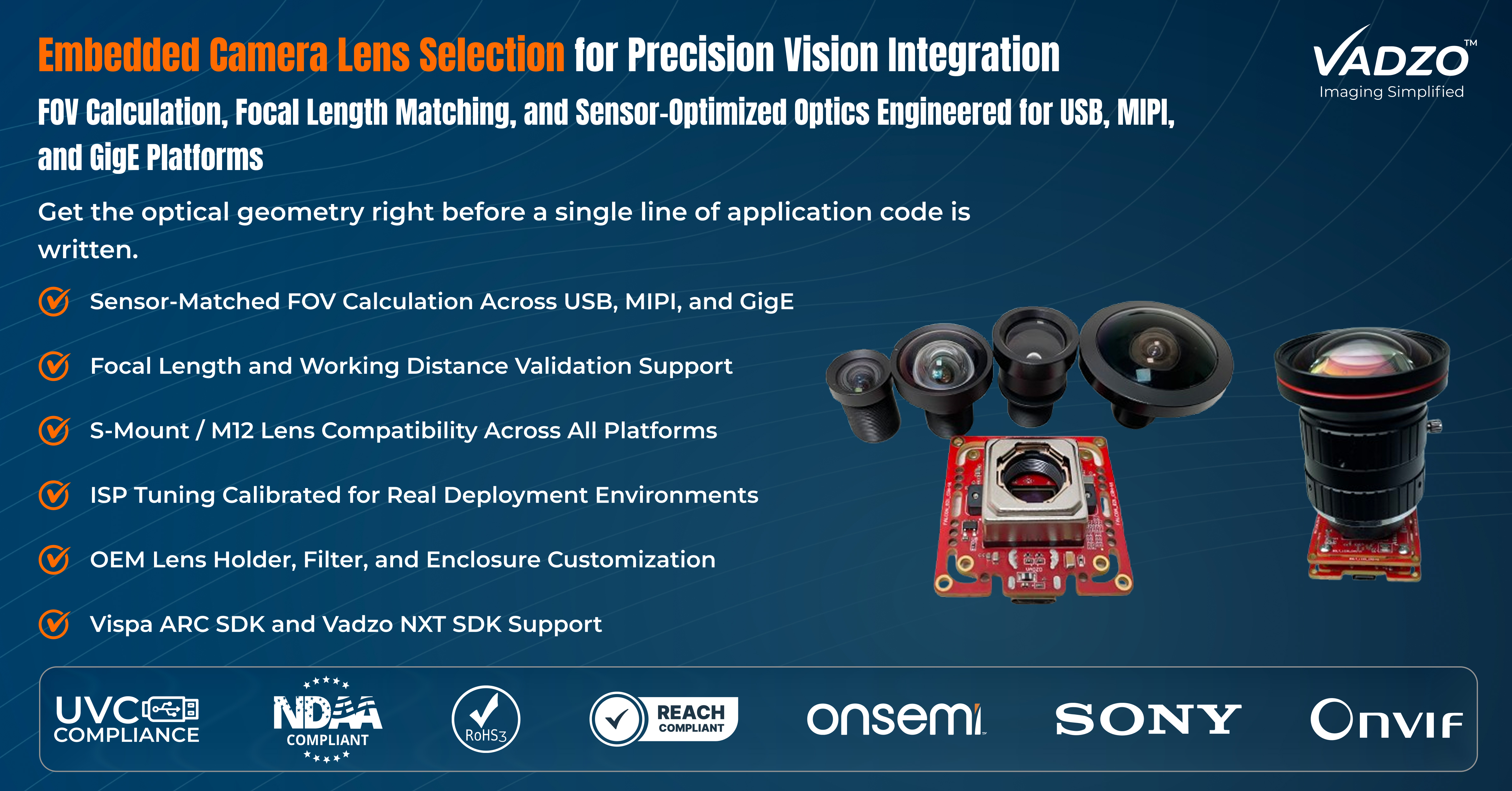
Vadzo’s embedded camera portfolio spans the MIPI camera series, Gigabit Ethernet camera series, and USB camera series, each targeting a distinct class of vision application with different working distance ranges, FOV requirements, and ambient lighting conditions. Across all three platforms, the embedded camera lens selection process follows the same deterministic optical geometry, and the variables that matter are always the same: sensor active width, required horizontal field of view at the target plane, and working distance. Beyond these three, four additional optical parameters F-number, total track length, relative illumination, and distortion profile define whether a lens truly performs in a deployed OEM system.
Vadzo Imaging, a provider of embedded vision camera for OEMs and system integrators, is addressing one of the most consequential and frequently underestimated decisions in vision system design: embedded camera lens selection. For engineers building production vision systems on any embedded platform, the lens is not a downstream accessory. It is the optical decision that fixes the relationship between sensor format, working distance, and usable field of view before a single line of application code is written. Get it wrong, and no amount of ISP tuning or software correction recovers the scene coverage, spatial resolution, or geometric accuracy the system requires.
Vadzo’s embedded camera portfolio spans the MIPI camera series, Gigabit Ethernet camera series, and USB camera series, each targeting a distinct class of vision application with different working distance ranges, FOV requirements, and ambient lighting conditions. Across all three platforms, the embedded camera lens selection process follows the same deterministic optical geometry, and the variables that matter are always the same: sensor active width, required horizontal field of view at the target plane, and working distance. Beyond these three, four additional optical parameters F-number, total track length, relative illumination, and distortion profile define whether a lens truly performs in a deployed OEM system.
Why Embedded Camera Lens Selection Cannot Be Deferred to Post-Integration
Lens selection errors surface late and cost disproportionately to fix. A mismatched embedded camera lens commits the hardware to a field of view that either leaves critical scene area outside the frame or wastes spatial resolution on background the algorithm ignores. For a high-resolution MIPI CSI-2 camera sensor, pairing a low-MTF embedded camera optics assembly with a 20MP sensor means the pixel count advantage the sensor provides never reaches the image plane. For a wide-area GigE camera in surveillance or traffic monitoring, choosing the wrong focal length at a 20-metre working distance shifts the horizontal coverage zone by metres, not millimetres.
The FOV calculation embedded camera formula is fixed: Focal Length equals Working Distance multiplied by Sensor Width, divided by Horizontal Field of View. This focal length embedded vision calculation applies equally to USB, MIPI CSI-2, and Gigabit Ethernet camera lens configurations. What changes across platforms is which variable dominates the design constraint. In close-range MIPI configurations, spatial resolution per millimeter at the target plane sets the floor for focal length selection. In wide-area GigE surveillance deployments, maximum scene coverage sets the ceiling. In autofocus USB configurations, working distance varies dynamically, and the optical field of view shifts accordingly across the focus range.
Sensor size calculation is the prerequisite step. The same focal length S-Mount camera lens produces a different optical field of view on a 1/1.7-inch sensor compared to a 1/2.8-inch sensor. All cameras across Vadzo’s embedded camera series use M12 camera lens mounts as the standard interface, and the OEM camera lens image circle must fully cover the sensor diagonal to avoid corner vignetting. Vadzo’s applications engineering team validates embedded camera optics selection against each camera’s sensor geometry during design-in.
Seven Optical Parameters That Define Embedded Camera Lens Performance
Selecting the right embedded camera lens requires evaluating seven interdependent optical parameters. Together they determine whether a lens specification translates into real-world imaging performance inside a deployed OEM system.
1. Lens Sensor Format
The lens image circle must fully cover the sensor diagonal. An undersized image circle produces corner vignetting that ISP correction cannot fully recover. Matching lens sensor format to the sensor diagonal is the first validation step before any other optical parameter is assessed. A lens rated for a smaller format than the sensor it is paired with will always underdeliver on resolution and uniformity, regardless of its focal length or aperture specification.
2. Focal Length
Lens focal length determines the angular relationship between the sensor plane and the scene. Short focal lengths capture wide fields of view; longer focal lengths narrow the field and increase apparent magnification at a given working distance. Focal length selection is always a function of sensor format, working distance, and required scene coverage, not a standalone lens specification. Every millimeter of focal length deviation shifts the coverage zone at the target plane, and in fine-pitch inspection applications that deviation introduces a measurable specification error.
3. Field of View (FOV)
Horizontal, vertical, and diagonal FOV are all derived from focal length and sensor dimensions. Horizontal FOV is the governing dimension in most machine vision and industrial vision lens configurations. FOV calculation for embedded camera applications must account for the active pixel area rather than the full sensor die dimensions, as any ISP cropping reduces the effective FOV from the nominal lens value. For wide-angle camera lens configurations, the effective horizontal field of view delivered after onboard dewarping is what the deployment zone must be sized against.
4. F-Number (Camera Aperture)
The F-number governs how much light the embedded camera lens admits per unit time. A lower F-number enables shorter exposures that reduce motion blur in industrial camera lens configurations where subjects are in motion. A higher F-number increases depth of field for configurations where focus must hold across a range of working distances without autofocus actuation. For HDR-capable sensors, camera aperture determines how much exposure headroom the sensor’s dynamic range architecture has available at each focus position, and it directly affects the quality of shadow and highlight recovery in high-contrast scenes.
5. Total Track Length (TTL)
TTL is the total physical distance from the front of the lens to the sensor image plane. In compact OEM camera enclosures, TTL is a hard mechanical constraint that limits which lenses physically fit within the housing depth. A lens with excellent MTF and low distortion that exceeds the available TTL envelope cannot be used, regardless of its optical performance. M12 S-Mount camera lens assemblies used across Vadzo’s embedded camera series are specifically suited to compact OEM enclosures because the M12 format keeps TTL short. When customizing optics for any platform, TTL must be validated against the enclosure geometry before optical performance is evaluated.
6. Relative Illumination
Relative illumination describes how uniformly light is distributed from the optical axis to the corners of the sensor. A lens with poor relative illumination produces corner darkening that ISP correction can only partially address, particularly at wide field angles. For wide-area GigE camera configurations with extreme field angles, relative illumination across the full image circle is characterized during lens qualification and compensated in the onboard ISP and dewarping pipeline. For high-resolution MIPI camera configurations, any relative illumination falloff at the sensor corners reduces effective spatial resolution at the image periphery, introducing measurement inconsistency in document scanning camera and inspection workflows.
7. Distortion
Barrel distortion bows straight lines outward from the image center. Pincushion distortion pulls them inward. Both are most pronounced at short focal lengths and wide field angles. For surveillance camera, traffic monitoring camera, and smart parking camera deployments where spatial geometry must remain accurate, uncorrected distortion corrupts the output that recognition algorithms process. Low distortion lens correction must be calibrated to the specific lens and field angle combination in use a generic correction applied without distortion characterization leaves residual geometric error that downstream AI inference cannot reliably compensate for.
“Embedded camera lens selection is where optical geometry and deployment reality intersect. Engineers who treat it as a late-stage decision consistently encounter coverage gaps, distortion artifacts, or resolution shortfalls that the sensor hardware cannot compensate for. Vadzo designs its embedded camera portfolio around characterized optics from the start, so OEM customers are working with known field of view envelopes, not estimates”. – Alwin Vincent, Product Manager, Vadzo Imaging.
One Lens Selection Framework. Three Platforms Vadzo Delivers Around It.
Vadzo’s embedded camera lens framework is applied across three purpose-built platforms, each matched to a distinct optical design scenario, deployment environment, and interface requirement.
Bolt-2020MRS: 20MP AR2020 NIR Monochrome MIPI Camera for High-Resolution Inspection and Document Scanning
High pixel count creates an optical design obligation: the embedded camera lens must resolve at the sensor’s Nyquist frequency, or the resolution advantage is irrelevant. The Bolt-2020MRS is Vadzo’s 20MP AR2020 NIR Monochrome MIPI camera, built on the ON Semiconductor AR2020 sensor at 1/1.8-inch format with 1.4-micron pixel pitch. Its monochrome configuration eliminates Bayer filter quantum efficiency loss, delivering better NIR sensitivity camera performance for structured-light, document scanning camera, and semiconductor inspection workflows. Four-lane MIPI CSI-2 at 1.5 Gbps per lane transfers the full 5120 x 3840-pixel array without bandwidth-induced compression. The Bolt-2020MRS integrates directly with NVIDIA Jetson and Raspberry Pi platforms through standard V4L2 driver support.
Key specs: 20MP (5120×3840) | Onsemi AR2020 | Rolling Shutter | 1/1.8″ 1.4μm Pixel | 4-Lane MIPI CSI-2 | NIR | S-Mount (M12) | -30°C to 70°C
Innova-662CRS: 1080p IMX662 Ultra Low Light GigE Camera for Wide-Area Surveillance and Traffic Monitoring
Wide-area surveillance camera and traffic monitoring camera deployments require a wide-angle camera lens at long working distance, which introduces barrel distortion that downstream license plate recognition software cannot tolerate uncorrected. The Innova-662CRS is Vadzo’s 2MP IMX662 Color Gigabit Ethernet camera, delivering 2MP FHD (1920×1080) at up to 60fps with up to 200 degrees diagonal field of view and onboard dewarping that delivers rectilinear video to the VMS without host-side overhead. Its Sony STARVIS IMX662 sensor provides NIR sensitivity camera performance for low-light camera operation, and Fusion HDR handles mixed-lighting zones that smart parking camera and security camera environments present. The Innova-662CRS operates under the Vadzo NXT SDK for full programmatic control across C, C++ and Python on Windows, Linux, and Android.
Key specs: 2MP FHD (1920×1080) | Sony IMX662 STARVIS 2 | Rolling Shutter | 1/2.8″ 2.9μm Pixel | GigE (100/1000Base-T) | ONVIF Profile S/T/G/M | PoE 802.3af | Fusion HDR | NIR | -40°C to 85°C
Falcon-821CRH: 4K AR0821 Color HDR USB 3.2 Gen 1 Camera with Autofocus for Kiosk and Medical Device Imaging
Variable working distance applications cannot use a fixed-focus embedded camera lens without accepting image softness outside the focus plane. The Falcon-821CRH is Vadzo’s 8MP AR0821 USB 3.2 Gen 1 camera with integrated optical autofocus, operating at up to 30fps at 3840×2160 with UVC, V4L2, and DirectShow compatibility requiring no proprietary driver. The AR0821 autofocus USB 3.2 camera delivers 140 dB HDR natively, covering the contrast range that kiosk camera and patient monitoring camera environments present. As working distance changes, the autofocus actuator adjusts focal length dynamically, shifting the optical field of view across the focus range. The Vispa ARC SDK provides programmatic autofocus control alongside streaming, exposure, and gain management.
Key specs: 8MP (3848×2168) | Onsemi AR0821 | Rolling Shutter | 1/1.7″ 2.1μm Pixel | USB 3.2 Gen 1 | 140 dB HDR | Autofocus | S-Mount (M12) | -30⁰C to +85⁰C
Vispa ARC and Vadzo NXT SDK: Camera Control for Embedded Vision Developers
The Falcon-821CRH AR0821 USB 3.2 camera is supported by Vadzo’s Vispa ARC SDK, providing full programmatic control over streaming, autofocus, exposure, gain, white balance, Region of Interest, and firmware updates. The Innova-662CRS IMX662 GigE camera is supported by the Vadzo NXT SDK, which extends control to encoding, GPIO, Smart GPIO, and camera parameters across the same language and platform support matrix. Both SDKs support C, C++ and Python on Windows, Linux, and Android, enabling OEM product developers and edge AI system architects to build and deploy custom vision applications with complete control over imaging performance. For teams using standard driver frameworks, the Falcon-821CRH operates natively under UVC, V4L2, and DirectShow without any proprietary driver dependency. The Bolt-2020MRS AR2020 MIPI camera integrates directly with NVIDIA Jetson and Raspberry Pi platforms through standard V4L2 driver support, reducing host-side development overhead in MIPI CSI-2 embedded deployments.
Embedded Camera Lens Applications Across the Bolt, Innova, and Falcon Platforms
High-Resolution Document Scanning and PCB Inspection: Bolt-2020MRS
Document scanning camera and printed circuit board inspection workflows operate at precisely controlled working distances, which allows focal length selection to target maximum spatial resolution at the image plane rather than wide scene coverage. The Bolt-2020MRS 4K AR2020 Rolling Shutter MIPI Camera delivers full 5120×3840 pixel readout across a four-lane MIPI CSI-2 interface, providing the spatial sampling density that fine-pitch feature inspection requires. A matched industrial camera lens at the target working distance validated for lens sensor format coverage across the 1/1.8-inch sensor diagonal and confirmed for TTL fit within the OEM enclosure captures sub-millimeter feature detail reliably across the full frame. For semiconductor inspection and NIR-based structured-light configurations, the monochrome sensor’s improved photon sensitivity across the near-infrared spectrum makes it the preferred choice over color alternatives where Bayer filter quantum efficiency loss would reduce NIR signal quality.
Wide-Area Surveillance, Smart City, and Traffic Monitoring: Innova-662CRS
Surveillance camera, smart parking camera, and traffic monitoring camera deployments place cameras at fixed positions covering large scene widths at extended working distances a combination that demands short focal lengths, wide angle camera lens configurations, and reliable distortion correction. The Innova-662CRS 2MP IMX662 Gigabit Ethernet Camera delivers up to 200-degree diagonal FOV with onboard dewarping, covering areas that would otherwise require multiple fixed-FOV camera units on a single PoE GigE cable run. Its Sony IMX662 STARVIS sensor maintains usable image quality in low-light camera conditions where ambient illumination drops below usable levels for conventional color sensors, and Fusion HDR manages the high-contrast transitions vehicle headlights against dark road surfaces, sunlit facades against shadowed entry points that outdoor monitoring environments present continuously. ONVIF Profile S/T/G/M compliance enables direct integration with existing video management systems and smart city monitoring platforms without proprietary driver dependencies.
Kiosk, Patient Monitoring, and Robotics Vision: Falcon-821CRH
Kiosk camera, patient monitoring camera, and robotics vision lens configurations share a requirement that fixed-focus optics cannot satisfy: working distance changes between subjects, sessions, or arm positions, and the embedded camera lens must maintain sharp focus without host-side intervention at each new distance. The Falcon-821CRH 4K AR0821 autofocus camera adjusts optical field of view dynamically across the full autofocus range, maintaining 8MP resolution at each focus position. For medical device camera applications including surgical imaging and diagnostic kiosk platforms, the 140 dB HDR architecture handles high-contrast clinical scenes bright display panels against darker subject backgrounds, overhead lighting with deep shadow zones without compressing detail at either end of the dynamic range. For robotics vision configurations where the end-effector working distance changes between pick positions, the onboard autofocus eliminates the fixed working distance constraint from the mechanical design entirely, and camera aperture selection governs the depth of field envelope at each arm position.
OEM Customization: Vadzo Delivers the Embedded Camera Lens System, Not Just the Hardware
For OEM product teams that need more than a standard camera module, Vadzo provides complete embedded camera lens system customization across all three platforms. The embedded camera lens, sensor configuration, enclosure, and firmware are treated as a single integrated solution rather than separate components the OEM must assemble and characterize independently.
The Falcon-821CRH 8MP AR0821 USB 3.2 camera can be customized with matched M12 optics selected for specific working distance ranges, TTL-validated lens holders, and autofocus calibration tuned to the OEM’s target focus envelope. For kiosk camera, medical device camera, and robotics vision lens deployments where the working distance range and subject geometry are known at design time, Vadzo characterizes the autofocus system against that range during the design-in process, delivering a camera that performs to specification in the actual deployment environment rather than a laboratory bench.
The Innova-662CRS 2MP IMX662 Color Gigabit Ethernet camera can be customized with IR and NIR LED array board integration, lens holder modifications for specific field angle requirements, IP-rated enclosure design for outdoor and semi-exposed installations, and ISP tuning calibrated for the specific ambient lighting conditions of the deployment zone. For surveillance camera, traffic monitoring camera, and smart parking camera deployments where scene geometry and lighting environment are defined, Vadzo tunes the dewarping pipeline and relative illumination correction against the actual lens and deployment FOV rather than a generic profile.
Across both platforms and the Bolt-2020MRS 20MP AR2020 MIPI Camera from Vadzo’s MIPI camera series, Vadzo provides board redesigns, firmware modifications, optical filter integration, and volume production support. ISP tuning for distortion correction, relative illumination compensation, and NIR sensitivity optimization is available per sensor and per deployment environment. OEM camera lens customization, including focal length selection validation, TTL confirmation, and aperture guidance, is part of the standard design-in engagement, not a premium service.
FAQ
1) How do I calculate the correct focal length for an embedded camera at a known working distance and field of view?
Focal length calculation comes down to three values you already know: your sensor’s active width, the horizontal field of view you need at the target plane, and the working distance. Multiply the working distance by the sensor width, then divide by the horizontal field of view, and you have your focal length. For the Bolt-2020MRS 20MP AR2020 Mono MIPI Camera with an approximately 11.6mm sensor width, targeting a 150mm horizontal FOV at a 500mm working distance, the required focal length is approximately 38.7mm. This focal length embedded vision calculation applies across USB camera lens, MIPI CSI-2 camera lens, and Gigabit Ethernet camera lens configurations. After calculating focal length, always validate that the selected lens covers the sensor format diagonal and that its TTL fits within the OEM enclosure before committing to the build.
2) What is TTL and why does it matter for embedded camera lens selection in compact OEM enclosures?
TTL, or Total Track Length, is the physical distance from the front element of the lens to the sensor image plane. In compact OEM camera enclosures, TTL is a hard mechanical constraint that determines which lenses physically fit within the housing depth. A lens with excellent MTF and low distortion that exceeds the available TTL envelope cannot be used regardless of its optical performance. M12 S-Mount camera lens assemblies used across Vadzo’s embedded camera series are specifically suited to compact OEM enclosures because the M12 format keeps TTL short. When requesting customized embedded camera lens assemblies through Vadzo’s OEM program, TTL is one of the first parameters the applications engineering team validates against your enclosure design before optical evaluation begins.
3) How does relative illumination affect image quality at wide field angles?
Relative illumination measures how uniformly the embedded camera lens distributes light from the optical center to the sensor corners. A lens with poor relative illumination produces visible corner darkening that ISP correction can only partially compensate for, particularly at wide field angles. For the Innova-662CRS IMX662 Color Rolling Shutter GigE camera with up to 200-degree DFOV, relative illumination across the full image circle is characterized during lens qualification and compensated in the onboard dewarping and ISP pipeline before video is delivered to the VMS. In security camera and traffic monitoring camera deployments where consistent image quality across the full scene width is required for recognition accuracy, uncharacterized relative illumination falloff introduces inconsistency that downstream analytics software cannot reliably correct.
4) When is a wide-angle camera lens appropriate, and how does Vadzo handle its distortion?
A wide-angle camera lens is appropriate when scene width is large relative to working distance the defining requirement in surveillance camera, smart parking camera, and traffic monitoring camera deployments. The Innova-662CRS 2MP IMX662 Color Gigabit Ethernet camera demonstrates this directly with its 200-degree field, covering areas that would otherwise require multiple fixed-FOV camera units. The limitation of wide-angle embedded camera optics is barrel distortion: short focal lengths bow straight lines at the image periphery, corrupting the spatial geometry that license plate recognition and analytics algorithms depend on. The Innova-662CRS corrects this onboard through its dewarping processor. Vadzo’s ISP tuning process characterizes the distortion profile per deployment environment, not as a generic correction.
5) How does F-number selection interact with HDR performance in the Falcon-821CRH?
Camera aperture, expressed as F-number, directly governs how much light reaches the sensor at a given shutter speed. For the Falcon-821CRH 4K AR0821 Color HDR USB 3.2 Gen 1 camera with 140 dB HDR, aperture selection determines the exposure headroom available at each autofocus position across a variable working distance range. A wider aperture enables shorter exposures that reduce motion blur in kiosk camera and patient monitoring camera environments. A narrower aperture extends depth of field for medical device camera configurations where focus must hold across a range of subject distances without continuous autofocus actuation. The interaction between aperture, autofocus position, and the AR0821 sensor’s HDR architecture means F-number selection is an integral part of the embedded camera lens specification process for this platform.
Availability
The Bolt-2020MRS 20MP AR2020 MIPI camera, Innova-662CRS IMX662 Gigabit Ethernet Camera, and Falcon-821CRH 4K AR0821 USB 3.2 Gen 1 camera are available for OEM evaluation. Engineering samples, technical documentation, embedded camera lens selection guidance, TTL validation support, and integration assistance are available directly from Vadzo Imaging. Volume pricing, firmware customization, optics, lens holder modifications, and enclosure design services are available on request. For inquiries, contact the Vadzo Imaging sales team at support@vadzoimaging.com.
About Vadzo Imaging
Vadzo Imaging develops high-performance embedded and machine vision cameras for OEMs and system integrators building next-generation intelligent systems. The company delivers imaging platforms across its USB camera series, MIPI camera series, and Gigabit Ethernet camera series, as well as Wi-Fi and SerDes interfaces, supporting applications in industrial automation, robotics, smart surveillance, smart city infrastructure, and edge AI. Beyond hardware, Vadzo provides end-to-end imaging expertise including sensor integration, ISP tuning, firmware development, embedded camera optics characterization, distortion calibration, and OEM camera customization services that accelerate development and deployment at scale.
Media Contact
Alwin Vincent
Vadzo Imaging
Email: alwin@vadzoimaging.com
LinkedIn: Vadzo Imaging
YouTube: Vadzo Imaging
X: Vadzo Imaging
SOURCE: Vadzo Imaging
View the original press release on ACCESS Newswire